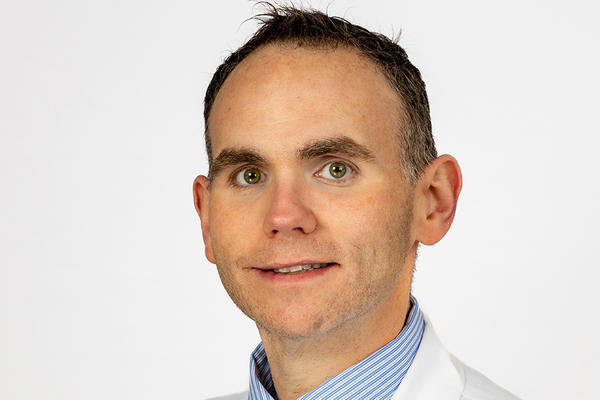



Avash Kalra, M.D. (’12)

Columns from Health Care Today
Avash Kalra, M.D., is an internal medicine resident physician at the University of Colorado in Denver. A 2012 graduate of Boonshoft School of Medicine, he earned his B.A. in Psychology from Cornell University, where he served as a columnist for the Cornell Daily Sun. He was a founder and co-host of Radio Rounds, a weekly medical talk show produced by students at Boonshoft School of Medicine.
Avash published the Notes from a Medical Student column during his second and third year in medical school.
Notes from a Medical Student
- Can I Go Home?
- Tell Me What You See
- Do You Want to Know a Secret?
- Let's Play It by Ear
- Frequently Asked Questions
- Three Letters Change Everything
- Left Breathless
Notes from a Medical Student:
Three Letters Change Everything
It was an unseasonably warm Tuesday afternoon in early December. Outside, the temperature had climbed to over 50 degrees. Inside, meanwhile, 100 second-year medical students filled an auditorium to listen to a physician's lecture-a routine occurrence, typically not worth mentioning.
Except, we discovered, this particular physician doesn't practice medicine anymore. He's now a patient instead.
Why? CTG.
CTG. A mere three letters. This column alone contains more than 1,000 times as many. Our genetic code-the personalized Rosetta Stone within each of us-contains letters too. Over three billion of them. And in one seemingly inconspicuous spot, on one tiny chromosome, a repetition of gene bases represented by the letters CTG results in a disease called myotonic dystrophy. While the disease is not necessarily terminal, it is incurable and degenerative.
In this case, the disease's mid-life onset and progression-with muscle wasting, an inability to relax muscles, vision problems, and even difficulty eating-led our guest, Dr. M, to halt his medical career long before he ever would have planned.
All because of three letters.
Certainly, at one point or another, all physicians experience the medical profession from the perspective of a patient. But most of us won't have to face a cruel genetic disease that can take away our ability to practice medicine. That's what had happened to our guest, though, and every student in the room-myself included-listened intently. Perhaps we were particularly captivated on that warm December day because not long ago, the patient in front of us had sat exactly where we did.
Dr. M told us he had learned the exact number of CTG repetitions in his DNA that had caused his ailment, and he described his pure relief when he found out that his son had not inherited the disease. After all, he had a 50 percent chance of doing so, and anything can happen when you flip a coin.
We can only wonder if Dr. M dwells much on the past, thinking of the years he spent training and the relatively brief time he was able to care for patients. F. Scott Fitzgerald's famous final line of The Great Gatsby-"So we beat on, boats against the current, borne back ceaselessly into the past"-describes that feeling, when we look to the past because our hope for the future has been compromised.
Still, the quote seems to insist that we move on, that we keep rowing, and whether our boat is with or against the current might be irrelevant, especially for a patient. And that may be the most memorable lesson from that afternoon-even though the physician's medical career had ended, he had gained a perspective that allowed him to continue being a doctor in the truest sense of the word.
"Doctor," after all, means "teacher" in Latin.
I can assure you, Dr. M had our full attention that afternoon. And he taught. At times, his story was inspirational. But he also described his devastation and bitter disappointment with brutal honesty.
By a rough estimate, my classmates and I may care for a combined 20 million patients over the next 50 years. That's 20 million mini-lessons within the ongoing education that defines this profession. Sometimes we will teach those lessons, and perhaps more often, we will learn-from other physicians and, most powerfully, from patients as well.
This time, we were able to learn from both at once. It was just one of many upcoming lessons, but I suspect it may prove to be one of the more memorable. Because of Dr. M's connection to us, of course, and his ability to show us two perspectives at once, his willingness to sit in front of 100 pairs of curious eyes, and his memorable sense of humor, which showed us his belief in always fighting against the current.
So, it turned out we weren't only lucky because it was a rare warm day in December.
Thanks to our guest, we were fortunate, most of all, to be inside.