accessible site map link

Detailed Table of Contents

Introduction

Academics

Assessment & Promotion

Class Rank

Transcripts & Permanent Grades

Absences

Religious Observances

Transfer

Professional Honor Code & Policy

Appeal of a Recommendation for Dismissal

Student Fair Treatment Policy

Drug Impairment

Mental Health

Health Requirements

Occupational Exposure to Bloodborne Pathogens

Medical Liability Coverage

Choosing a Specialty, Applying to Residencies, Matching & Graduation

Boonshoft Physician Leadership M.D./M.B.A. Program

The M.D./Ph.D. Program in the Biomedical Sciences

Equality, Affirmative Action & Harassment

Safety & Security

Professional Honor Code & Policy

Rationale

The heritage of a physician's social conduct emerged from acknowledged community standards dating back to the Oath of Hippocrates. A critical aspect of medical students' professional development is to assign one's self to a life guided by a code of ethics, endorsing a commitment to moral, ethical, and professional fidelity. Therefore, all students of the Wright State University Boonshoft School of Medicine are expected to pledge their allegiance to upholding a professional honor code. This honor code was designed to foster a culture of personal integrity and intellectual development during students' quest to become licensed doctors of medicine.

Medical Student Honor Code Pledge

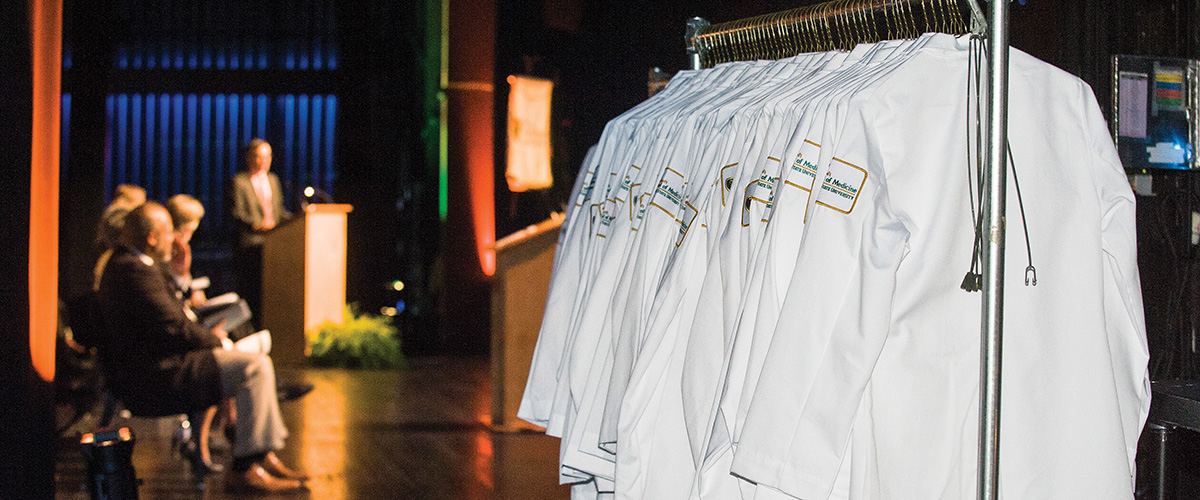
At the Convocation and White Coat ceremony, a representative of the Medical School Student Council leads the class in reciting the following Medical Student Honor Code Pledge:

I publicly acknowledge and accept the privileges and responsibilities given to me today as a physician in training and dedicate myself to provide care to those in need.
I will approach all aspects of my education with honesty and integrity, embracing opportunities to learn from patients, teachers, and colleagues. I will value and respect the knowledge and wisdom of the physicians who have preceded me.
I will maintain the highest standards of professional conduct academically, clinically, and socially.
I will certify only that which I have personally verified, and I will neither receive nor give unauthorized assistance on examinations.
I will recognize my weaknesses and strengths and strive to develop those qualities that will earn the respect of my patients, my colleagues, my family, and myself. I will continue to value my relations with those who have supported me in the past and those who will share in my future.
I will strive to earn the trust my patients place in me and the respect that society places upon my profession. I will respect the humanity, rights, and decisions of all patients and will attend to them with compassion and without bias, maintaining patient confidentiality, remaining tactful in my words and actions.
I will value the diversity of patients’ experiences, cultures, and beliefs because it enhances my ability to care for them and enriches my education. I will remember that medicine is an art as well as a science and that warmth, sympathy, and understanding are integral to patient care.
I will recognize the privileges afforded to me as a physician-in-training and promise not to abuse them. As a student I will remain aware of my responsibilities to improve the standard of health in my community, to increase access to care for the underserved, and to advance medical knowledge.
By accepting these new responsibilities, I will remember the importance of my own health and well-being as well as those of my colleagues.
Knowing my own limitations and those of medicine, I commit myself to a lifelong journey of learning how to cure, relieve, and comfort with humility and compassion.
I make this pledge solemnly, freely, and upon my honor.

Student Responsibilities

  • It is the duty of the student to recite and sign the medical student honor code pledge. This signed pledge will become a permanent part of the student's academic file.
  • The student will read and understand the Student Policy Guide that addresses attributes of professionalism.
  • Students should adhere to all established federal, state, and local laws and follow all regulations established by Wright State University and the affiliated institutions.
  • Patients are to be treated with respect without regard to race, personal beliefs, religion, ethnicity, gender, sexual orientation, physical handicap, or socioeconomic status.
  • Breech of patient confidentiality is a violation of the honor code.
  • Plagiarisms of material or misrepresenting submitted work as being a product of a student's own personal creative effort is a violation of the honor code. When outside sources of information are used, the student should reference appropriately.
  • Cheating or giving unauthorized academic aid to other students by any method in order to gain an advantage on tests, assignments, or research projects, is a violation of the honor code.
  • Falsifying clinical reports, patient records, university materials or experimental research data is a violation of the honor code.
  • Restricting access to reference materials used by students to prepare for examinations or clinical assignments is a violation of the honor code.
  • Fraudulently assisting or knowingly misleading another student in order to place one in academic jeopardy is a violation of the honor code.
  • Sexual, physical, mental or verbal abuse/harassment of patients, peers, faculty, staff, or others is a violation of the honor code.
  • Theft or malicious damage of property is a criminal offence and a violation of the honor code.
  • The use or possession of illicit drugs are violations of the honor code.
  • Ingesting alcohol, or non-prescribed mood altering drugs while on call or during clinical duties is a violation of the honor code.
  • Misrepresentation of a student's status as a physician or resident is a violation of the honor code.
  • Failure to fulfill mandatory clinical duties, responsibilities and/or assignments demonstrates a lack of appropriate professionalism judgment and is a violation of the honor code.

Since no code can predict all conceivable instances of honor code violations, the student has the responsibility to always act in a professional manner and to seek clarification from appropriate sources if their or another student's conduct is suspected to be in conflict with the intended spirit of the honor code.

The Honor Code Council

The Honor Code Council (hereinafter referred to as the Council) will serve as the body responsible for assuring that students accused of honor code violations receive due process in the form of fair and impartial hearings. The council will consist of nine members, three faculty members appointed for two-year terms by the Dean of Medicine, four students, the Associate Dean for Student Affairs (hereinafter referred to as the Associate Dean) or his/her administrative appointee and the chairperson. Annually, each medical school class will be responsible for electing one delegate and one alternate representative to the Council. The chairperson of the Council will be an impartial administrative or faculty member appointed by the Dean of Medicine.

Reporting Violations of the Honor Code

When students or faculty observe what appears to be a violation of the honor code, he/she should confront the individual(s) with their concern(s) in a professional and discrete manner. Through discussion one may confirm that a breech of the honor code did not occur in many instances. When this self-regulating person-to-person interaction does not resolve the concern, the observer should report it to an examination proctor, faculty member, course director, or preceptor as soon as possible. Also, students and faculty should report alleged violations to the Associate Dean and provide any physical evidence or documentation that substantiates the alleged violation.

For allegations of academic dishonesty, copies of the student's work with a written explanation should be provided.

For allegations of misconduct on an examination, a copy of the examination and details regarding the process of discovery should be provided.

For allegations of plagiarism, copies of the original source with the plagiarized text highlighted should be provided.

Administrative Responsibilities

The Associate Dean will assess the evidence supporting the alleged violation so as to protect the student from libel, defamation of character or unsubstantiated allegations. He/she will determine if sufficient cause for investigation exists and attempt to resolve the concern when the evidence is judged insufficient to warrant formal investigation by the Council.

The Associate Dean will be circumspect in reviewing allegations and in interacting with faculty and students. He/she will maintain strict confidentiality when investigating allegations of improper behavior.

If in the course of investigating student misconduct the Associate Dean observes conduct by a student that requires immediate intervention, he/she may do so to protect the welfare of others. A formal hearing by the Council will be scheduled as soon as possible following such action.

The Associate Dean will notify the chairperson of the Council within seven working days of the reported violation and schedule a meeting of the council within 30 days of the filing of the report.

Honor Code Council Procedures

  1. The student charged with a violation will be given written notification in person or by certified mail of the date, time, and location of the hearing at least seven working days in advance. This written notification will include a description of the alleged violation, a copy of the Professional Honor Code, a list of the Council members, and the names of any witnesses who will give testimony at the hearing. If the student chooses not to appear before the Council as notified the hearing will be conducted in the student's absence.
  2. Prior to the hearing, the student has the right to challenge the objectivity of a member by communicating his/her concerns to the chairperson in writing. The chairperson may consult with the Associate Dean and the Council member in question to determine if he/she should be disqualified. Any member of the Council who believes they have a conflict of interest may disqualify him or herself. If a student member of the Council is disqualified, an alternate will replace him/her.
  3. The student may select a faculty or administrative advisor to assist them prior to and during the hearing.
  4. The student's appearance before the Council is a confidential academic hearing and not a legal proceeding; therefore an attorney may not accompany the student.
  5. In order to preserve the integrity of the testimony presented at the Council hearing, sessions will be audio taped and archived with the printed summary.
  6. The student is encouraged to present a written and/or verbal rebuttal to the allegations and may ask witnesses to be present.
  7. At the hearing evidence supporting the allegation will be presented.
  8. The student or their assistant may question witnesses.
  9. At the conclusion, Council members will deliberate in private and make a recommendation by majority vote. The chairperson will not vote except in the event of a tie.
  10. The Council may consider previous infractions of the Honor Code, including infractions determined by the Student Promotions Committee, in arriving at a recommendation.
  11. The Council may take one of the following actions:
    1. No corrective action when there is insufficient evidence to support the allegation of an honor code violation.
    2. A sealed written reprimand to be placed in the student's academic file that chronicles the violation. The reprimand will remain sealed and be destroyed after the student's graduation if there are no further honor code violations.
    3. A written reprimand to be placed in the student's academic file that chronicles the violation. This information can be included in the student's Medical Student Performance Evaluation (Dean's letter) and remain a permanent component of the student's file.
    4. Require that the student seek professional assistance at his or her own expense.
    5. Require specific conditions that must be fulfilled to continue as a student.
    6. Require that the student's examination/report/product or experience be discarded, that an incomplete be assigned to the academic record, and that the student be required to satisfactorily complete compensatory work or be re-evaluated on relevant facts to demonstrate a mastery of the material.
    7. Require that a course grade of "F" or "No Pass" be assigned. The student's remedy for the failing grade will be to repeat the entire course with a notation of "Failed Course Due to Academic Dishonesty" appearing on the transcript. The Council has the option of expunging this notation from the student's transcript at a later date or upon graduation.
    8. Require a temporary suspension with the notation of "Suspended for Violation of Honor Code" permanently placed on the transcript.
    9. Recommend to the Dean of the medical school permanent dismissal with the notation of "Dismissed for Violation of Honor Code" placed on the transcript.

Appeal of a Decision by the Council

A formal appeal may be requested by the student after he/she has received written notification of the Council's recommendation and consulted with the Associate Dean. The request for an appeal should be submitted in writing to the Associate Dean within seven working days of the receipt of the Council 's recommendation. The written request should describe the specific reasons for the appeal, including any special or mitigating circumstances, and additional relevant information that was not available for consideration at the initial hearing.

Requests for an appeal will be considered for the following reasons:

  1. There was a procedural error during the investigation and/or the hearing.
  2. There was clear evidence of a Council member's bias against the student due to discrimination on the basis of race, gender, religion, national origin, physical handicap, age, sexual orientation, or political affiliation or belief.
  3. Previously unreported mitigating circumstances or evidence is newly discovered.

An alleged error in judgment by the student is not an appropriate basis for requesting an appeal.

If practical, the appeal will be heard at the next meeting of the Council or within four weeks of receiving the written request. The student will be given written notification in person or by certified mail of the date, time, and location of the appeal at least seven working days in advance. The student may request to appear before the Council and may be accompanied and assisted by a member of the university faculty or administration. The Council's recommendation regarding the appeal will be final.

Appeal of a Recommendation for Dismissal

The Student Appeals Committee considers student appeals of dismissal recommendations made by the Student Promotions Committee, the Honor Council or other relevant committees empowered to make such recommendations.

The committee consists of four faculty appointed for a four year term and one student appointed for a one year term by the Dean of Medicine. The members cannot simultaneously serve on the Student Promotion Committee or Honor Council. The dean for student affairs or designee is an ex officio member of the committee. The Dean of Medicine designates one member of the Student Appeals Committee to serve as chair. The dean may, with the concurrence of the majority of the committee members, appoint an additional faculty member for a one-year term.

  • The Office of Student Affairs and Admissions will notify the student in writing of a recommendation for dismissal that is being forwarded to the Dean of Medicine. The notification will indicate the reasons for the recommendation and will advise the student of the process and time limitations of an appeal.
  • The Dean of Medicine will notify the student of its receipt and provide the student with an opportunity to request an appeal in writing within seven working days. Failure to request an appeal within the allotted time renders the recommendation final.
  • The Dean of Medicine will convene the Appeals Committee within four weeks of receiving the request for an appeal. After reviewing all relevant evidence, the Appeals Committee will give the student an opportunity to present information warranting reconsideration of the recommendation. The student may be accompanied and assisted by a member of the university faculty or administration at the appeal.
  • The Appeals Committee will deliberate and by majority vote confirm or reject the recommendation for dismissal. The committee’s decision and all relevant evidence will be forwarded in writing to the Dean of Medicine.
  • The Dean of Medicine will review the evidence and notify the student by certified letter of the Dean’s decision.
  • A student may appeal the Dean of Medicine’s decision to the Provost of the University. The student’s written appeal must be submitted to the Provost within seven working days of receiving the Dean of Medicine’s written decision. The Provost’s decision is final. Failure to appeal within the allotted time renders the Dean of Medicine’s decision final.

Approved by the Executive Committee on June 8, 2006