accessible site map link
Dr. Steve Berberich

Steven J. Berberich, Ph.D.
Interim Chair and Professor

Office: 114 Diggs Lab
Lab: 104 Diggs Lab
(937) 775-3041
E-mail: Dr. Berberich

Education:

Ph.D.: 1990 Wright State University (M. Leffak)
Postdoctoral: Princeton University (M.D. Cole)

Research:

Since 1993, the laboratory has been studying cellular regulators of the p53 tumor suppressor protein. Our first NIH grant (R29, 1995-2000) focused on examining the role of the Mdm2 protein on regulating p53 function. Those studies led several novel discoveries including a mdm-2 chromosomal translocation (Oncogene 9:1469-1472, 1994), mdm-2 gene amplification (Differentiation 64:205-212, 1999) and Mdm-2 phosphorylation (Cancer Research 57:5013-5016, 1997). The mdm2 gene deregulations (translocation/gene amplification) are consistent with the observation that overexpression of Mdm2 protein can inhibit the p53 tumor suppressor activity. Mdm2 phosphorylation by DNA-PK represented the first example of a posttranslational modification that negatively impacted Mdm2 association with p53.

We then began to study mdmX, a mdm2 related gene that unlike mdm2, was not p53-regulated (DNA and Cell Biology, 9:99-104,1999). Our subsequent five-year NIH grant (R01, 2000-05) focused on the role of MdmX protein on p53 function. Based on MdmX overexpression studies using mammalian cell lines we demonstrated that MdmX could inhibit p53 transactivation and block Mdm2 mediated p53 degradation (Molecular and Cellular Biology, 20:1001-1007, 2000). Like Mdm2, MdmX could bind to and was inactivated by the tumor suppressor ARF (J. Biol. Chem. 276:25336-25341, 2001). Also during this award period we uncovered that MdmX can inhibit deregulated activity from the E2F1 transcription factor (Cell Cycle 3:472-478, 2004) directly opposing effects we observed with Mdm2 (Oncogene 21:4414-4421, 2002). Additionally, we provided novel findings with respect to MdmX regulation of p63 (DNA and Cell Biology 20: 321-330, 2001), Smad transactivation (Oncogene 21:8776-8785, 2002) and the role of Mdm2/X ring finger domains on p53 activity (Biochemistry 42:2291-2299, 2003).

Our current competitive five-year NIH grant (R01, 2006-10) continues our studies on MdmX but combines RNAi approaches with our gene expression profiling capabilities (Center for Genomics Research) in an effort to further understand the effects of MdmX deregulation on the p53 pathway. Recent reports have shown that deregulation of the human homolog of MdmX appears to represent one genetic alteration that allows human tumors to bypass p53 function. Our primary goal is to test whether loss of MdmX can improve cancer therapies in human tumors harboring wild-type p53 that is inactivated by the deregulation of either Mdm2 or MdmX.

While the majority of our research at Wright State University has focused on p53 regulators, the Center for Genomics Research has enabled the laboratory to initiate several new research collaborations. One project examining the role of 2-deoxy-glucose treatment of glioblastomas prior to irradiation has led to a recent publication with a group in India (Cancer Biology and Therapy, 5(7) 815-823, 2006) and a pending clinical trial where CGR will provide gene expression profiling of glioblastoma biopsies. Collaborations involving rat skin toxicogenomics, schizophrenic patient genotyping and lung cancer gene expression profiling are currently ongoing.


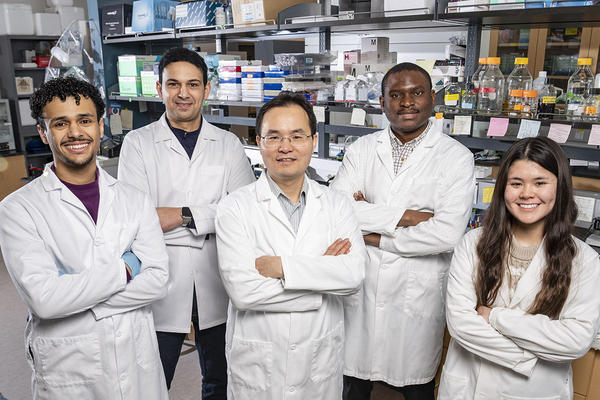
Current Research Personnel

Graduate Students:
  • Kevin Kelley, M.D./Ph.D. candidate, 2nd year (Ph.D. program)
  • Brooke Andrews, Ph.D. candidate, 2nd year
  • Kelly Miller, M.D./Ph.D. candidate, 1st year (Ph.D. program)
  • Meghna Jani, Master's candidate, 2nd year
  • Meldrick Mpagi, Master's candidate, 2nd year
  • Amy Kelley, Anatomy Master's candidate, 2nd year
Undergraduate Students:
  • Heather Wood
  • Nisha Pandey
  • Benjamin Schmitt
  • Christina Hurley
  • Paige Westrick
  • Caitlin Meyer